


Table of Contents
Hysterectomy in Pembroke Pines: What You Need to Know
If you are researching hysterectomy in Pembroke Pines, you likely have many questions. A hysterectomy is the surgical removal of the uterus, often recommended for conditions like uterine fibroids, endometriosis, abnormal bleeding, pelvic organ prolapse, or cancer. We understand that deciding to have a hysterectomy is a big step, and we are here to support you every step of the way.
We offer several surgical approaches, including vaginal, abdominal, laparoscopic, and robotic-assisted hysterectomy. A robotic hysterectomy is a minimally invasive hysterectomy that uses advanced technology for enhanced precision, typically resulting in less pain, smaller scars, and a faster return to normal activities. According to the American College of Obstetricians and Gynecologists (ACOG), these techniques often shorten recovery periods. Depending on your diagnosis, the ovaries may also be removed -- a procedure called salpingo-oophorectomy. Your board-certified gynecologist will help you decide which option is best for your unique situation.
Recovery after hysterectomy varies from two to six weeks based on the surgical approach, and our team will guide you through a personalized recovery plan. We invite you to schedule a consultation at our Pembroke Pines location to discuss what's right for you. We also see patients from Miramar; learn more about Hysterectomy Miramar Fl. Please note that individual results and recovery experiences may vary.
Understanding Hysterectomy: Conditions and Treatment Options
Now, let's explore a common gynecologic procedure: hysterectomy.
What Is a Hysterectomy?
A hysterectomy is the surgical removal of the uterus, as described by the U.S. National Library of Medicine. It can be total, removing both the uterus and cervix, or partial (supracervical), which leaves the cervix intact. The surgery is performed through three main routes: abdominal, vaginal, and laparoscopic or robotic. Minimally invasive hysterectomy techniques, including robotic hysterectomy, use small incisions and result in less postoperative pain and a quicker return to daily activities compared to open surgery.
Common Conditions Treated with Hysterectomy
Hysterectomy may be recommended when less invasive treatments have not provided sufficient relief. According to the American College of Obstetricians and Gynecologists (ACOG), several gynecologic conditions may lead to this surgery:
- Uterine fibroids: benign growths causing heavy bleeding and pressure; hysterectomy is an option when medication or myomectomy are not effective.
- Endometriosis: uterine-like tissue grows outside the uterus, causing pain and possible infertility; surgery is considered when hormonal therapies fail.
- Adenomyosis: the uterine lining thickens inside the muscle wall, leading to severe cramping and heavy periods; hysterectomy may be the definitive treatment.
- Uterine prolapse: weakened pelvic muscles allow the uterus to descend into the vagina; after conservative measures, hysterectomy can provide relief.
- Abnormal uterine bleeding: heavy or irregular bleeding unresponsive to hormonal treatment or endometrial ablation may require hysterectomy.
- Gynecologic cancers: endometrial, cervical, or uterine cancers that often necessitate hysterectomy as part of the treatment plan.
For each of these conditions, hysterectomy is typically reserved for when other therapies are unsuccessful.
Non-Surgical Alternatives to Consider
Before deciding on hysterectomy, we encourage you to explore all options with a board-certified OBGYN. ACOG guidelines highlight several effective alternatives, including hormonal medications and NSAIDs to manage symptoms, endometrial ablation for heavy bleeding, uterine artery embolization (UAE) to shrink fibroids, and myomectomy to remove fibroids while preserving fertility. The right path is highly individualized, and we believe in a collaborative approach--your doctor will help you weigh the benefits and risks of each alternative.
When Is Hysterectomy the Right Choice?
The decision to proceed with hysterectomy depends on personal factors such as your age, overall health, the severity of your condition, desire for future fertility, and your own preferences. At First Class OBGYN, we take the time to listen and provide a thorough, personalized evaluation. A board-certified gynecologist Pembroke Pines at our practice can guide you through every step, ensuring you feel informed and supported. If you're considering hysterectomy in Pembroke Pines, we are here for you with Expert Attentive Care. Understanding your options is the first step; next, we'll discuss the different surgical approaches and our minimally invasive expertise.
Please consult a healthcare professional for personalised medical advice and diagnosis.
Benefits of Minimally Invasive Hysterectomy in Pembroke Pines
When considering a hysterectomy in Pembroke Pines, many women want to understand the advantages of a less invasive approach. At First Class OBGYN, we believe in educating our patients so they can make informed decisions. Minimally invasive techniques offer significant benefits over traditional surgery, from smaller incisions to a faster return to daily life. Let's explore the key advantages and how they compare to open surgery.
Key Advantages of Minimally Invasive Surgery
Minimally invasive hysterectomy includes laparoscopic and robotic approaches that use several tiny incisions rather than a single large abdominal cut. According to guidelines from the American College of Obstetricians and Gynecologists (ACOG), these procedures result in:
- Incisions: 0.5-1 cm each, compared to a 6-8 inch open incision.
- Pain: Less postoperative pain and reduced opioid requirements.
- Blood loss: Minimized bleeding during surgery.
- Hospital stay: Outpatient in most cases, versus 2-3 days with open surgery.
- Recovery: Return to normal activities in 1-2 weeks, not 6-8 weeks.
- Infection: Lower wound infection rates.
- Cosmetic: Smaller, less noticeable scars.
These advantages mean you can recover at home soon after surgery and get back to your routine quickly. Many women who choose a minimally invasive hysterectomy in Pembroke Pines appreciate the swift return to family and work.
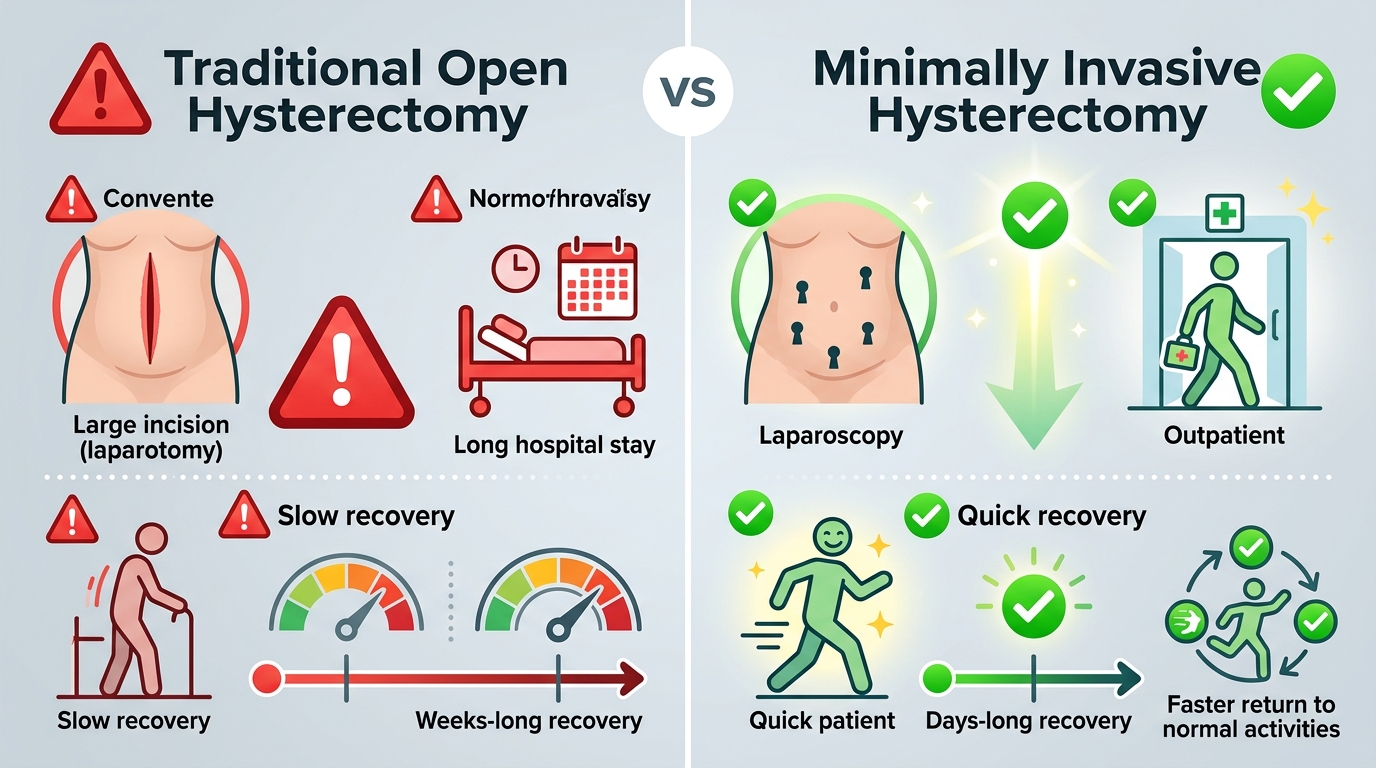
Comparison of traditional vs minimally invasive hysterectomy benefits
Comparison with Traditional Open Surgery
In a traditional open abdominal hysterectomy, the surgeon makes a single 6-8 inch incision in the lower abdomen, while minimally invasive surgery uses 3-5 small keyhole incisions. The difference in pain is significant; open surgery patients often require stronger pain medications, whereas those having a minimally invasive procedure typically find over-the-counter options sufficient. Hospital stays for open surgery average 2-3 days, but most minimally invasive patients go home the same day. The recovery timeline also contrasts sharply: 6-8 weeks for open surgery versus only 1-2 weeks for a laparoscopic or robotic hysterectomy. ACOG data also indicate a lower risk of wound infections and hernias with the minimally invasive route. Of course, candidacy depends on individual factors, and your surgeon will help you decide the safest approach for your health.
Robotic vs. Laparoscopic: What the Research Shows
Both robotic-assisted and laparoscopic hysterectomy are proven minimally invasive options. National Institutes of Health (NIH)-funded studies confirm that they share similar safety profiles and long-term outcomes. The choice often rests on surgeon expertise and patient-specific factors.
Robotic surgery offers the surgeon a 3D high-definition view and wristed instruments, which can enhance precision in complex cases--such as a large uterus or dense adhesions. Laparoscopic hysterectomy, performed without the robot, is equally effective for straightforward cases and remains a well-established technique. For women in Pembroke Pines, our practice is led by a board certified obgyn who is committed to helping women restore their confidence through personalized, minimally invasive surgery. With Expert Attentive Care, we are here for you every step of the way.
With a clear understanding of the benefits, let's explore what to expect during your minimally invasive hysterectomy procedure and recovery.
Results may vary based on individual patient conditions and circumstances. Please consult a healthcare professional for personal medical advice.
How a Minimally Invasive Hysterectomy Is Performed
If you are considering a hysterectomy in Pembroke Pines, understanding the step-by-step process can help you feel more confident. At First Class OBGYN, we are committed to helping women restore their confidence with expert attentive care, and we guide you through each stage of a minimally invasive hysterectomy with warmth and clarity. Here is what you can expect before, during, and after the procedure.
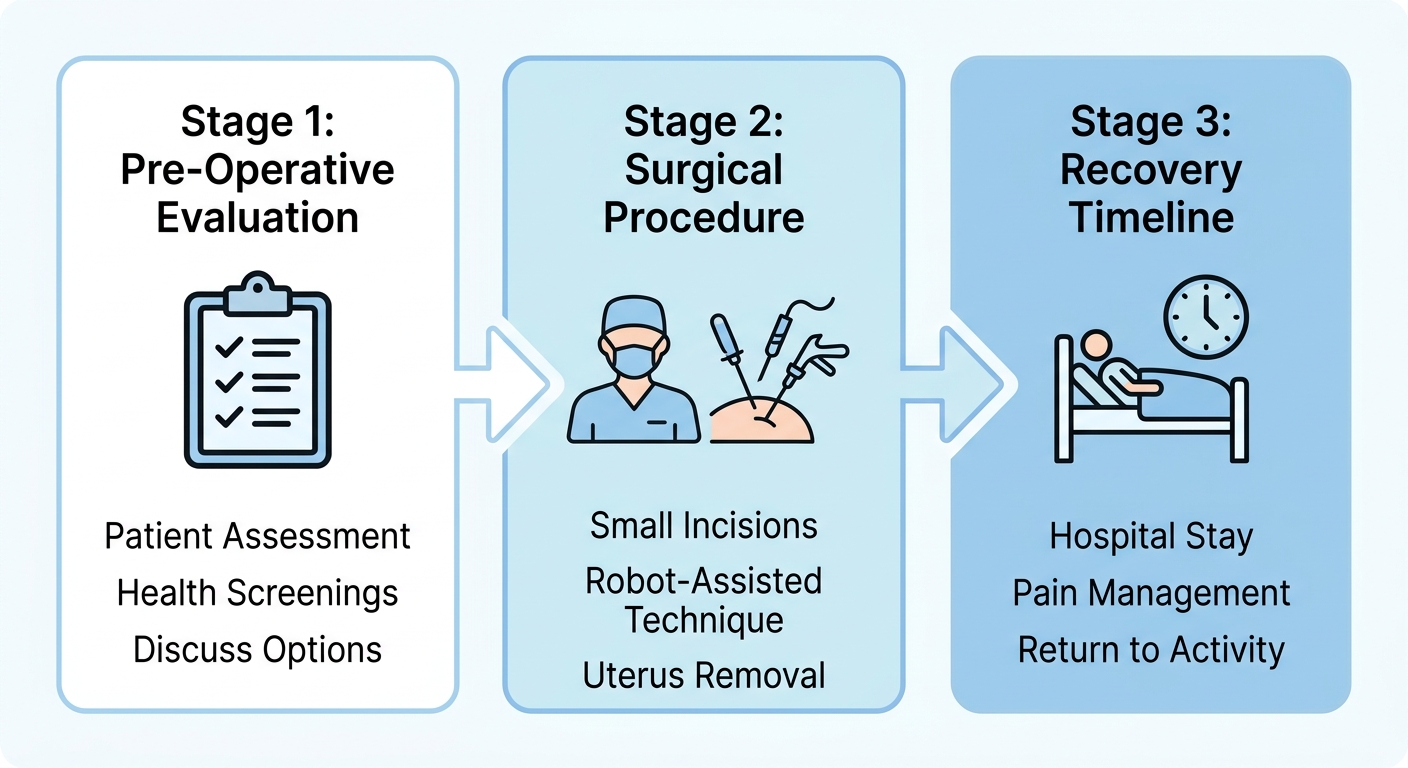
Three stages of minimally invasive hysterectomy procedure
Pre-Operative Evaluation and Preparation
Before surgery, we perform a thorough evaluation to ensure you are a suitable candidate. This includes a review of your medical history, imaging (ultrasound or MRI if needed), and blood work. You'll receive detailed instructions: stop blood thinners as directed, follow a bowel preparation with clear liquids and a laxative, and avoid all food and drink after midnight the night before. Government health guidelines from the National Institutes of Health emphasize that these steps reduce surgical risks. During your pre-operative appointment, we explain the plan and answer all your questions so you feel fully supported.
The Surgical Procedure: Laparoscopic and Robotic Approaches
At our Fort Lauderdale practice, we offer minimally invasive Hysterectomy Fort Lauderdale options for women seeking advanced care. Our robotic hysterectomy procedure uses the state-of-the-art da Vinci robot, which allows surgeons to perform complex surgery through small incisions with exceptional dexterity. The entire procedure is performed under general anesthesia so you remain comfortable and pain-free. Typically, the surgery lasts between one and three hours.
Here is what happens step by step:
- Incisions and Insufflation: The surgeon creates three to five tiny incisions in the abdomen. Carbon dioxide gas is gently introduced to expand the abdominal cavity, giving a clear view of the surgical field.
- Insertion of Instruments: A laparoscope (a thin, lighted camera) and slender surgical tools are inserted through the incisions.
- Dissection and Removal: The surgeon carefully separates the uterus from its supporting structures. The uterus is then removed either through the vagina or through one of the small abdominal incisions, using a specialized bag to prevent tissue spillage.
- Closure: The instruments are withdrawn, the gas is released, and the incisions are closed with sutures or surgical glue.
For a robotic-assisted hysterectomy, the surgeon sits at a console controlling the da Vinci robot with hand and foot controls, translating movements in real time with enhanced magnification and precision. This robot-assisted hysterectomy approach often results in less blood loss and less post-operative discomfort. Whether laparoscopic or robotic, the goal is the same: a safe, effective procedure with minimal disruption to your body.
Recovery Timeline and Hospital Stay
After surgery, you awaken in the PACU where we monitor your vitals and manage pain. Most patients stay one night; same-day discharge is possible. At home, avoid lifting over 10 lbs for four to six weeks and do not drive for a week or while on narcotics. A minimally invasive hysterectomy involves smaller scars, less pain, and a quicker return to normal life. Watch for fever above 101°F, heavy bleeding that soaks a pad an hour, or severe pain not controlled by medication--call us immediately. Sedentary work can resume in two to three weeks; physically active jobs in four to six weeks. Each person heals differently, so please consult a healthcare professional, as individual results may vary. We are here for you every step of the way.
Understanding the recovery process helps set realistic expectations. Next, we'll discuss the advantages of choosing a minimally invasive approach. If you have questions or would like to schedule a consultation, contact our office today.
Best Practices for Hysterectomy Preparation and Recovery
Once you and your surgeon have decided on the best approach, preparing for a hysterectomy in Pembroke Pines can feel overwhelming--but careful planning makes recovery smoother and less stressful. Our team at First Class OBGYN is here to guide you every step of the way, whether you need Expert Attentive Care in Miramar, Weston, or beyond.
Preparing for Hysterectomy: Logistics and Mindset
Getting your home and schedule ready before surgery is one of the most empowering things you can do. If you are planning a hysterectomy Fort Lauderdale, our team can help you get ready with these practical steps:
- Arrange at least two weeks off work (more for an abdominal hysterectomy).
- Stock your freezer with easy-to-prepare meals and snacks.
- Set up a recovery station with pillows, water, medications, and your phone within arm's reach.
- Pack a hospital bag with loose-fitting clothes, slip-on shoes, personal toiletries, and anything that helps you feel comfortable.
- Arrange for a trusted friend or family member to drive you home and stay with you for the first day or two.
Pre-surgery nerves are completely normal. Practice deep breathing or a short mindfulness exercise each day, and remember: we are here for you. If any last-minute questions or fears surface, call our office--our staff in South Florida is always ready to offer reassurance.
Questions to Ask Your Surgeon Before Scheduling
Your pre-operative consultation is the moment to get clear, honest answers. Speaking up helps you feel confident and in control. We encourage all of our patients, whether they see us in Pembroke Pines or Fort Lauderdale, to bring a list of questions. Here are the most important ones to cover:
- What type of hysterectomy do you recommend for my specific condition?
- Will my hysterectomy be laparoscopic, robotic, or abdominal?--ask specifically about the benefits of a robotic hysterectomy and whether a minimally invasive hysterectomy could shorten my recovery.
- Approximately how many of these procedures have you performed?
- If I hope to preserve fertility, what are my options?
- What does the typical recovery look like for the approach you recommend?
- Are there non-surgical alternatives I should consider before moving forward?
- What should I do if pain is not controlled with the medication you prescribe?
Surgeons who have extensive experience with advanced approaches like robotic hysterectomy can often complete the surgery with smaller incisions, which may translate to a smoother early recovery. Still, every person's situation is unique, and you should feel free to ask all of your questions until you feel completely comfortable.
Post-Operative Care: A Week-by-Week Guide
After your discharge, the weeks that follow are a steady progression toward feeling like yourself again. The following outline, based on guidance from the American College of Obstetricians and Gynecologists (ACOG), reflects a typical recovery--but your surgeon's specific instructions always take priority.
- Week 1 - Rest is your main job. Take pain medication as needed, get up for short walks around the house, and strictly avoid driving. Stick to a high-fiber diet (think prunes, oats, and fresh vegetables) and use a stool softener to prevent constipation, which can worsen discomfort.
- Week 2 - Gradually increase walking time to 10-15 minutes. Continue to avoid lifting anything over 10 pounds. If you are no longer taking narcotic pain medication and feel alert, you may be cleared to drive, but confirm with your surgeon first.
- Weeks 3-4 - Many patients return to light desk work during this window. Still, heavy lifting, strenuous exercise, and intense abdominal work remain off limits. Listen to your body and rest when you feel tired.
- Weeks 5-6 - After your follow-up visit, your surgeon will likely clear you for full activity. Begin a gradual return to exercise, and remember that stamina rebuilds slowly.
Call your doctor right away if you notice any of these warning signs: a fever over 100.4°F, heavy bleeding that soaks a pad in an hour, severe pain not relieved by medication, leg swelling or redness (which could signal a blood clot), difficulty urinating, or wound drainage that looks like pus. We are here for you in South Florida, and no concern is too small to bring to our attention. Following these best practices--and your individualized discharge plan--will help you recover comfortably and confidently.
Moving Forward with Hysterectomy Care in Pembroke Pines
With your decision made, the next phase of care begins. Moving forward with hysterectomy in Pembroke Pines involves a clear, supportive recovery plan tailored to you and your specific needs. At First Class OBGYN, we guide you through every step following your procedure.
Recovery after hysterectomy is unique for each woman. For patients who underwent robotic hysterectomy, recovery may be shorter, while all minimally invasive hysterectomy approaches often allow a faster return to daily activities. Following guidelines from the American College of Obstetricians and Gynecologists (ACOG), we provide personalized activity restrictions, follow-up visits at our Pembroke Pines location, and ongoing post-surgery care. Our expertise in robotic and laparoscopic techniques means you receive Expert Attentive Care every step of the way. We are committed to helping women restore their confidence and ensuring you feel supported throughout your healing. We also address pain management and emotional well-being, providing the reassurance you need to recover comfortably.
Our team, including our dedicated women's health specialist Fort Lauderdale, collaborates with you throughout your recovery. Please reach out to schedule a follow-up or ask any questions. We are here for you. Results may vary based on individual patient conditions and circumstances.


