


Table of Contents
Understanding Your Egg Supply and Reproductive Health
If you're wondering how to check egg supply, the answer is a simple blood test for anti-müllerian hormone (AMH) and a transvaginal ultrasound to count antral follicles, both of which estimate your ovarian reserve. This estimate reflects the remaining quantity of eggs in your ovaries.
Women are born with their lifetime supply of eggs, and as time goes on, that quantity drops off. After age 35, the decline tends to accelerate and egg quality deteriorates. This means conceiving can become much more difficult.
Understanding your ovarian reserve offers valuable insight for family planning, though it cannot predict pregnancy with certainty. According to the American Society for Reproductive Medicine (ASRM), no single test can determine a woman's ability to conceive, so providers use the results to tailor personalized care.
After understanding the significance of your eggs to your fertility, the next step is to learn about the assessment process itself, an area where our team provides expert attentive care to guide you.
Preparing for Your Egg Supply Assessment
Assessing your ovarian reserve starts with a visit to your OB/GYN.
This simple blood test measures something called the anti-Mullerian Hormone (AMH), which we know to be really sensitive. AMH levels can be measured on any day of your cycle, which means that there’s no need to plan for your visit based on when you’re expected to have this test done. A quick blood draw gives us valuable insight into the number of eggs remaining in your ovaries.
Antral follicle count (AFC) involves a transvaginal ultrasound where the doctor measures small follicles (from 2mm to 10mm), each containing a developing egg. The test is conducted using sound waves instead of radiation.
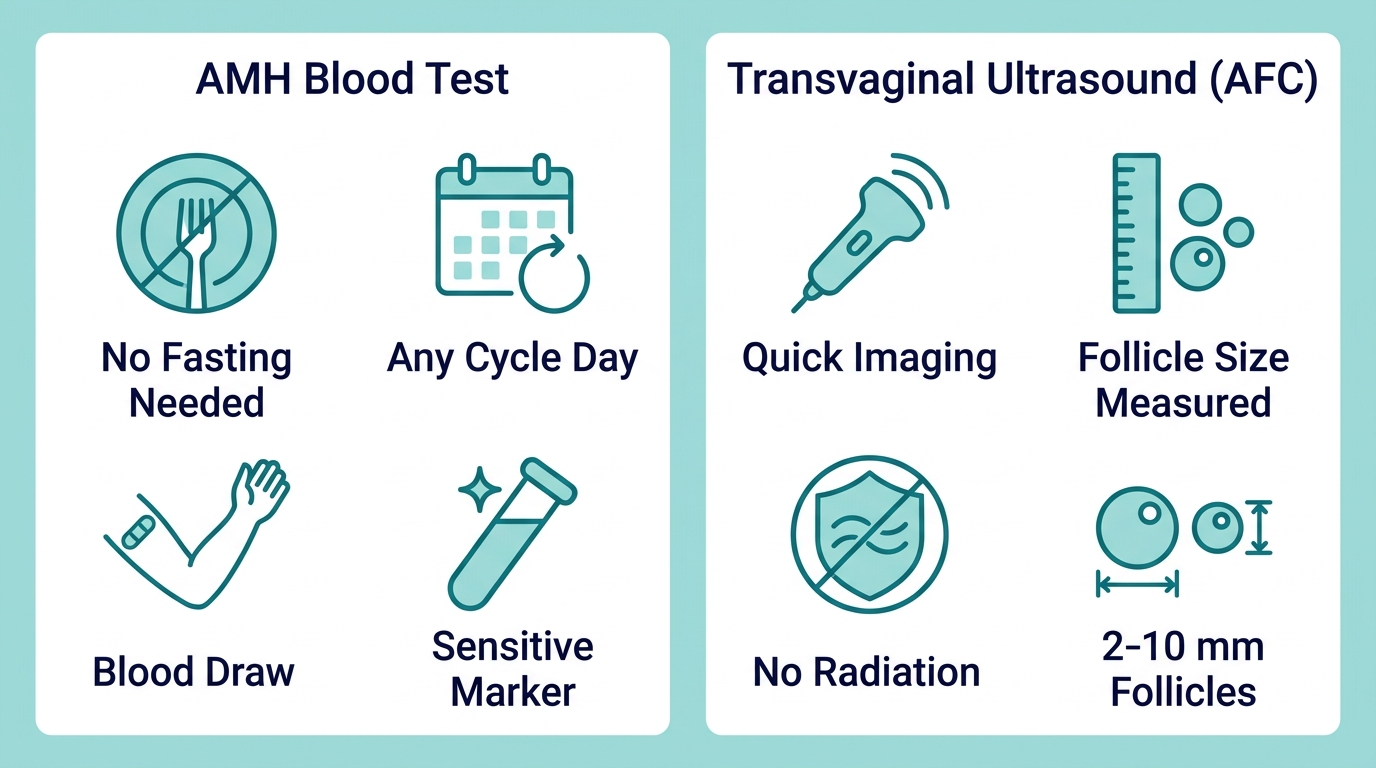
The American Society For Reproductive Medicine says there isn't really one test that will tell you how fertile you are, but they look at all your test results to give you a personal treatment plan. At a Miramar consultation, doctors talk about the patient's period as well as ordering any needed tests during their time.
Once you understand all this, you can start exploring how ovarian reserve affects fertility.
Step 1: Learn the Basics of Ovarian Reserve and Egg Supply
Your ovarian reserve is the number and quality of eggs you have remaining at any stage of your life. It can be considered the stock of egg supplies stored in the ovaries that helps regulate whether you can get pregnant and maintain normal functions of women’s organs related to reproduction.
Every female is born with all the eggs she will ever have, and that number progressively declines with age. Not only does the number decline, but egg quality also deteriorates with age.
When the time comes to explore how your own egg supply is measured, having this foundational knowledge makes the results more meaningful and easier to discuss. At First Class OBGYN, we are here for you every step of the way.
Step 2: Recognize Signs of Diminished Egg Quality
Once you understand your ovarian reserve and egg count, you may wonder what signs to look for. A few common signals can help you recognize potential changes early.
Aging is key here, as the years go by, egg quality and quantity can shift naturally. There isn't a single age that fits everyone, and many women factor their biological clock into family planning.
If you notice any modifications in how your period comes about, this could also signal reduced egg quality. Periods can become shorter, longer, heavier, lighter, or occasionally skipped.
Another possibility that may tell you why your egg supply could have dropped is if you’re having trouble getting pregnant. In some cases, women who aren't able to conceive may find they don't have enough eggs left to start their families.
If you notice any of these signs, a simple AMH blood test can measure your ovarian reserve and bring clarity. At First Class OBGYN, we offer a wonderful blending of friendly and professional support to help you understand your egg supply.
Step 3: Get Your AMH Level Tested
The second action to take following the identification of potential indicators of poor egg quality is to test your AMH levels. Anti-Müllerian hormone (AMH) is a reliable marker for the quantity of eggs in your ovaries. ASRM explains that your AMH levels reflect your egg supply, which can be taken throughout the menstrual cycle.
We can have you complete a simple blood test at an appointment in our office, and results should be back in just a few days. Although it provides valuable information about fertility, there isn’t any single test we can rely on to determine if you will become pregnant. If your AMH value turns out lower than what would be expected based on your age, the ASRM says this means you have fewer egg reserves, however, does not state you cannot ever become pregnant. And conversely, even with normal levels, it doesn’t necessarily indicate that you’ll definitely become pregnant. Your results assist us in determining which treatments might benefit you most as part of an overall fertility evaluation.
After you get your AMH results, testing other hormones including follicle-stimulating hormone and estradiol can help clarify ovarian function.
Step 4: Have FSH and Estradiol Blood Tests Done
Follicle-stimulating hormone (FSH) and estradiol are two hormones we measure through a blood test to help assess your ovarian reserve. These levels are informative when drawn early in your menstrual cycle—on day 3. A high FSH level can signal that the ovaries are working harder to produce eggs, which may indicate diminished reserve.
We also test for estradiol since high estradiol levels can artificially lower FSH readings, masking a potential issue. We will consider this in combination with your AMH result, as well as antral follicle count (AF), to give us a more complete idea of how many eggs you might have left. Patient education provided through the ASRM says that there is no one test which determines if pregnancy can happen at any given time, and having elevated FSH does not rule out the possibility that conception will still occur.
Once you get your blood work done, the second step in the fertility workup for you involves a transvaginal ultrasound where we measure antral follicles as well, because we need both pieces of information in order to come up with what your plan should be.
Step 5: Undergo a Transvaginal Ultrasound for Antral Follicle Count
A transvaginal ultrasound for antral follicle count (AFC) offers a direct view of the ovaries, counting the small resting follicles that represent your current egg supply. According to the American Society for Reproductive Medicine (ASRM), this test counts follicles between 2 mm and 10 mm in diameter — the tiny structures where eggs develop. While AFC is valuable, it is only one piece of the ovarian reserve picture. Learning how to check egg supply involves several tests, and this ultrasound step works alongside hormone blood tests to give a more complete understanding. The ASRM notes that no single test, including AFC, can guarantee a woman’s ability to become pregnant; results are interpreted together with other assessments to guide treatment decisions. We will review your AFC results in combination with your blood work to provide a thorough evaluation of your fertility health and recommend personalized next steps.
Step 6: Interpret Your Fertility Test Results with Your Doctor
Interpreting the results of your fertility tests takes an expert. No single blood test or sonogram can tell if you can get pregnant. These numbers look daunting, but we will take time to explain their meaning. We'll meet with you at our Miramar location and review your anti-müllerian hormone (AMH) level along with your antral follicle count (AFC), which gives us a more complete picture of your ovarian reserve. The American Society for Reproductive Medicine refers to AMH as a sensitive marker that can be drawn at any point during your menstrual cycle, while the AFC from your transvaginal ultrasound shows what your developing eggs look like. After looking at all four numbers, your AMH, AFC, FSH and estradiol, we put it all together to show the entire story of your fertility potential. Then using all of those results, we tailor a treatment plan just for you. Knowing your egg supply makes discussing your family planning options much easier.
If your fertility testing with a doctor shows that your supply of eggs has led to a condition called premature ovarian insufficiency (POI), then you need to know that ASRM defines this as the loss of ovarian function before age 40 and occurs in approximately 1 per cent of women. Diagnosing the problem will involve hormone levels in a blood panel plus a thorough clinical assessment by a reproductive endocrinologist, which could include chromosome analysis.
Most medical providers recommend Hormone Replacement Therapy (HRT) in order to reduce the occurrence of hot flashes and vaginal dryness, and also decrease other long-term risks associated with POI, like osteoporosis. There may be no “cure” for POI but HRT will help improve your quality of life. Your doctor will customize HRT specifically according to each patient’s requirements. They will work with you to ensure the right balance for your health profile. Understanding these treatment approaches can help address common concerns about egg supply testing, which we’ll explore next.
Troubleshooting Common Concerns About Egg Supply Testing
No specific blood work or ultrasound will tell you if you will be able to have babies, but these tests provide your physician with vital information needed to develop a treatment plan tailored to your body. For example, Anti-Mullerian Hormone (AMH) can be measured at any time during your menstrual cycle, which makes it convenient.
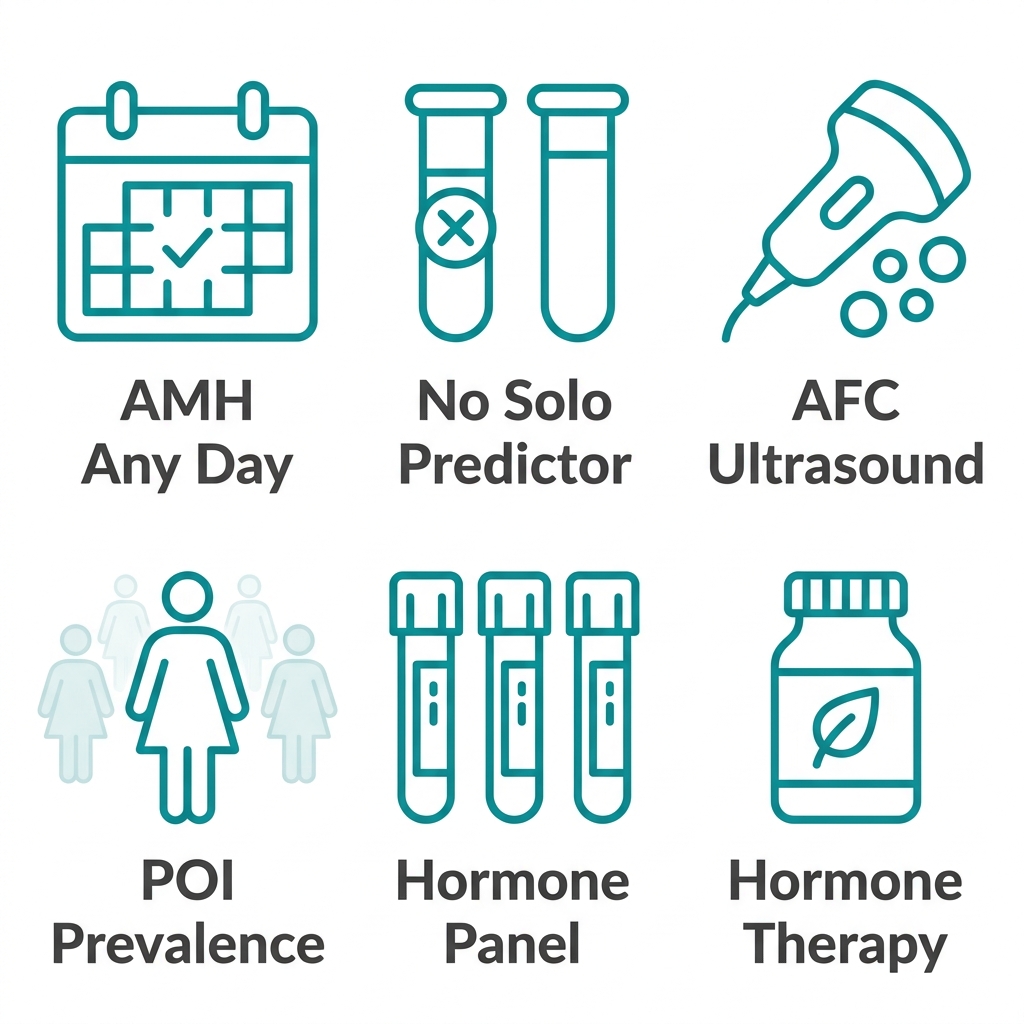
According to ASRM, the antral follicle count is actually a vaginal ultrasound and not a blood test. Using the probe, your doc will be able to see your ovaries as well as count the follicles measuring in between 2mm and 10mm.
If a woman has very low levels of AMH in her blood and an abnormally low AFC, she might be told that she has premature ovarian insufficiency (POI), a condition where ovarian failure occurs prior to age 40. About 1 percent of all women develop this problem. Despite its negative consequences, just because your AMH level or AFC count is low doesn't necessarily mean you will get diagnosed with POI; more testing such as a blood sample for a full panel of hormones would then be done and your doctor consulted. If POI is diagnosed, management typically focuses on hormone replacement therapy to ease symptoms and to reduce long-term risks of osteoporosis and heart disease.
If you choose our practice, we'll take all this information into consideration when making up a treatment plan just for you. Whether your ovarian reserve is robust or diminished, we'll guide you through options, from in vitro fertilization to donor egg programs.
Understanding how to check egg supply is a significant first step, and the next is finding care that interprets those results in the context of your whole health. We approach fertility with a personalized plan that respects your medical history, your goals, and your comfort. Dr. Laviniu Anghel and our team serve South Florida from offices in Miramar, Pembroke Pines, and Weston, offering consultations in English, Romanian, and Spanish so that language is never a barrier to thorough, empathetic care. Our practice combines advanced diagnostics with transparent guidance, helping you make informed decisions about your reproductive future. We invite you to schedule a conversation where we can listen carefully and outline paths that suit your needs. Results may vary based on individual patient conditions and circumstances. Please consult a healthcare professional for personalised medical advice and diagnosis.
Start Your Egg Supply Assessment
You've now learned exactly how to check your egg supply, from understanding ovarian reserve to interpreting AMH, FSH, estradiol, and antral follicle count results. Each of these tests provides a piece of the puzzle, and combining them with a doctor's expertise leads to a personalized fertility plan. In South Florida, we offer comprehensive fertility evaluations that include all the necessary blood work and ultrasound assessments. Our board-certified OB/GYN, Dr. Laviniu Anghel, will walk you through your results in English, Spanish, or Romanian, ensuring you feel informed and supported. With offices in Miramar, Weston, and Pembroke Pines, expert care is convenient for patients across the region. You can reach us at (954) 507-4494 to schedule your appointment and take the first concrete step toward understanding your fertility potential. Personalized attention and clear next steps await you.
Start Your Egg Supply Assessment


