


Table of Contents
Understanding Pelvic Floor Therapy in Fort Lauderdale
Pelvic floor therapy in Fort Lauderdale is a gentle, non-surgical rehabilitative approach designed to strengthen the muscles that support the bladder, uterus, and bowel. It is an effective treatment that helps women regain control and comfort without the need for invasive procedures.
This specialized form of physical therapy addresses a range of conditions that affect many women. According to the American College of Obstetricians and Gynecologists, it is highly effective for managing issues such as pelvic organ prolapse, where organs descend due to weakened support, and urinary incontinence, which involves the involuntary loss of bladder control. Many women seek pelvic floor therapy in Fort Lauderdale for relief from these same challenges, as well as chronic pelvic pain and overactive bladder symptoms.
Our team uses a suite of therapeutic methods tailored to your needs. These include biofeedback to improve muscle awareness, targeted pelvic floor exercises to build strength, gentle electrical stimulation to retrain nerves, and manual therapy to release muscle tension. These techniques can be used as a standalone treatment or combined with other urogynecological care. We provide Expert Attentive Care and remain committed to helping women restore their confidence.
Our practice in Fort Lauderdale specializes in Urogynecology Fort Lauderdale, where we integrate pelvic floor therapy into personalized care plans. We are here for you. Results may vary based on individual patient conditions and circumstances, so we encourage you to schedule a consultation to learn more.
The Basics of Pelvic Floor Health
For women in Fort Lauderdale, understanding pelvic floor therapy starts with knowing the basics of how these important muscles function. At First Class OBGYN, we are here for you, committed to helping women restore their confidence with Expert Attentive Care. The pelvic floor is a remarkable hammock-like group of muscles and connective tissues that stretches from the pubic bone to the tailbone. It provides critical support for your bladder, uterus, and rectum, and plays a central role in core stability, urinary and bowel control, and sexual function.
The table below contrasts healthy pelvic floor function with common signs of dysfunction, illustrating how these muscles impact everyday life.
| Pelvic Floor Function | Normal State | Dysfunction Symptoms |
|---|---|---|
| Organ Support | Bladder, uterus, and rectum held in place by strong muscular sling | Sensation of pressure, bulging, or visible organ descent (prolapse) |
| Urinary Continence | Sphincters contract reflexively to prevent leakage during cough, sneeze, or exercise | Stress incontinence (leakage with activity) or urge incontinence (sudden strong need to urinate) |
| Bowel Control | Coordinated relaxation allows stool passage; resting tone maintains continence | Fecal urgency, accidental leakage, or incomplete evacuation |
| Sexual Function | Muscles contract rhythmically during arousal and orgasm; vaginal tone supports intercourse | Pain during intercourse, reduced sensation, or inability to achieve orgasm |
When the pelvic floor is working well, these functions occur seamlessly. But when the muscles become too weak or too tight, pelvic floor muscle dysfunction can lead to distressing symptoms that affect quality of life. For instance, a weakening of the supportive structures can result in a pelvic organ prolapse, creating a sensation of pressure or bulging. Similarly, urinary incontinence, such as unexpected leakage with a cough or sneeze, affects millions of women across the country (National Institutes of Health, 2023). These pelvic support issues are nothing to be embarrassed about; they are common medical conditions that can be effectively addressed.
Our team provides a wonderful blending of friendly and professional care to help you understand your body and explore your options. Many women find significant improvement through targeted treatment. Understanding these dysfunctions is the first step; next we explore how pelvic floor therapy can help restore function and quality of life. If you recognize any of these symptoms, learning about pelvic floor therapy conditions can help you understand your options. We are dedicated to guiding you through every step of your care at our South Florida locations. As with any medical treatment, results may vary based on individual patient conditions and circumstances.
How Pelvic Floor Therapy Addresses Common Conditions
Now let's explore how pelvic floor therapy addresses the most common conditions affecting women. For women in Fort Lauderdale, pelvic floor therapy offers effective, non-surgical solutions for a range of intimate health concerns. We understand that discussing pelvic floor disorders can feel daunting, but our team is here for you with Expert Attentive Care. Our urogynecologist pelvic floor treatments begin with a thorough evaluation to create a personalized plan that targets your specific symptoms and goals, helping you regain comfort and confidence.
Pelvic Organ Prolapse: Causes and Conservative Management
The pelvic floor muscles act as a hammock, supporting the bladder, uterus, and rectum. When these muscles weaken due to childbirth, aging, or chronic straining, one or more organs can descend into the vagina, a condition known as pelvic organ prolapse. Prolapse is staged as mild, moderate, or severe. Pelvic floor therapy is a first-line treatment for mild to moderate cases, focusing on strengthening the supportive structures. According to the American College of Obstetricians and Gynecologists, conservative management is a crucial initial step. Specific techniques we may incorporate include core strengthening exercises to stabilize the pelvis, biofeedback to improve muscle awareness, and sometimes vaginal cone therapy. We also guide you through essential lifestyle modifications, such as avoiding heavy lifting and managing constipation, to reduce intra-abdominal pressure and prevent symptom worsening.
Urinary Incontinence: How Therapy Restores Control
Urinary incontinence affects millions of women, but it is not a normal part of aging. Stress incontinence causes leakage during physical activities like coughing, sneezing, or exercising, while urge incontinence involves a sudden, intense need to urinate, often with leaks before reaching the bathroom. Pelvic floor therapy is highly effective in restoring bladder control. Our approach retrains the pelvic floor muscles and bladder habits, often incorporating Kegel exercises with meticulous attention to proper form, bladder training with scheduled voiding, and techniques like electrical stimulation. These methods help you relearn control, and many women see a dramatic reduction or complete resolution of leakage episodes without the need for surgery, which aligns with guidance from major healthcare institutions.
Chronic Pelvic Pain and Hypertonic Pelvic Floor
Chronic pelvic pain is often linked to a hypertonic pelvic floor, where the muscles are in a constant state of tension and cannot fully relax. This dysfunction can contribute to conditions like vulvodynia and interstitial cystitis, causing persistent pain, discomfort with intercourse, or pain during bowel movements. Our therapy for hypertonicity shifts from strengthening to relaxation. We utilize manual therapy techniques, including both internal and external myofascial release, to alleviate muscle tension and treat trigger points. We also teach relaxation strategies such as diaphragmatic breathing and reverse Kegels to help you consciously release the pelvic floor. This process is central to our commitment to helping women restore their confidence. The expected outcome is a significant reduction in pain intensity, improved tolerance for daily activities, and a decreased reliance on pain medication.
The following table provides a quick comparison of how we tailor therapy to the three most common pelvic floor conditions:
| Condition | Common Symptoms | Therapy Techniques | Expected Outcome |
|---|---|---|---|
| Pelvic Organ Prolapse | Bulging sensation, pelvic pressure, discomfort with standing or lifting | Core strengthening, biofeedback, vaginal cone therapy, lifestyle modifications | Reduced prolapse symptoms, improved organ support, often avoids surgery in mild-moderate cases |
| Urinary Incontinence | Leakage with cough, sneeze, exercise (stress) or sudden strong urge to urinate (urge) | Kegel exercises, bladder training, electrical stimulation, timed voiding | Significant reduction or resolution of leakage episodes, improved bladder control |
| Chronic Pelvic Pain | Persistent pain in lower abdomen, pelvis, or perineum; pain with intercourse or bowel movements | Manual therapy, myofascial release, relaxation techniques, trigger point treatment | Reduced pain intensity, improved daily function, less reliance on pain medication |
This table, supported by data from ACOG and IU Health, illustrates the direct link between a specific diagnosis, the targeted techniques we use, and the realistic, positive changes you can work toward. It highlights how a personalized pelvic floor rehabilitation program can be a powerful alternative or complement to more invasive procedures.
Additional Conditions Addressed by Pelvic Floor Therapy
Beyond these primary conditions, pelvic floor therapy offers relief for a broader spectrum of issues. Our comprehensive approach can address:
- Fecal Incontinence: Improving anal sphincter control and coordination to manage accidental bowel leakage.
- Dyspareunia: Treating painful intercourse through manual therapy and relaxation techniques to release tight, tender muscles.
- Pelvic Girdle Pain: Providing stabilization exercises and manual support for pain in the pelvic joints, often during or after pregnancy.
- Pre/Postnatal Pelvic Support: Preparing the pelvic floor for childbirth and facilitating a safer, more complete recovery afterward.
We provide a wonderful blending of friendly and professional care to address these sensitive issues. Individual treatment outcomes depend on patient factors and clinical circumstances. Understanding how therapy helps these conditions is the first step. Next, we'll discuss the specific benefits you can expect and how to access care in Fort Lauderdale.
What to Expect During Your First Pelvic Floor Therapy Visit
If you are seeking pelvic floor therapy in Fort Lauderdale, your first visit with us at First Class OBGYN is designed to be a comfortable, judgment-free experience. We take time to listen to your concerns -- whether you are dealing with urinary incontinence, pelvic organ prolapse, or other pelvic dysfunctions -- so that we can create a plan that truly fits your needs.
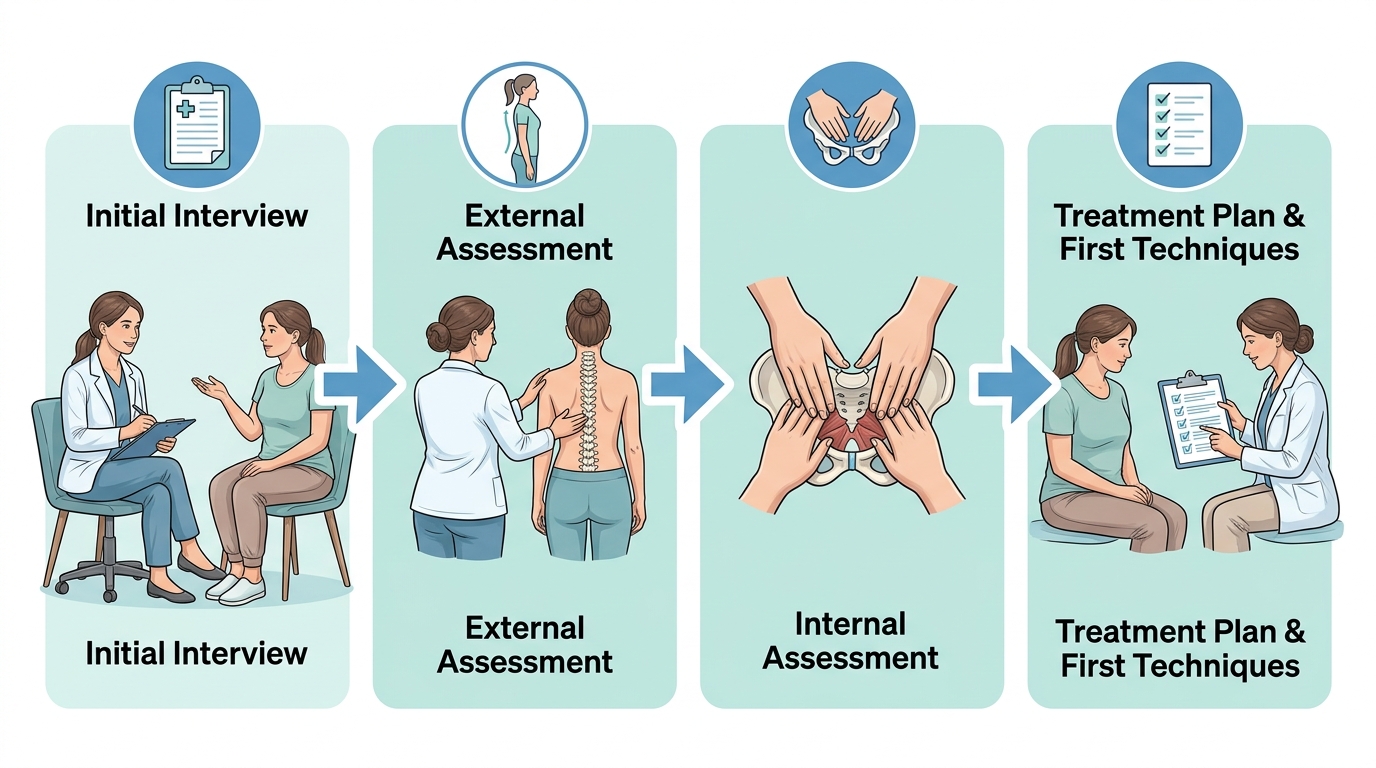
Four connected stages of a pelvic floor therapy visit
From the moment you book your first pelvic floor appointment, we work to make every step clear and reassuring.
Preparing for Your Appointment
A little preparation goes a long way toward a smooth first visit. If your insurance requires a referral, please request one from your primary care provider before scheduling; we are also available to help you verify your coverage. Wear loose-fitting clothing such as yoga pants or shorts so you can move comfortably during the initial pelvic floor evaluation. Bring any relevant medical records and a completed bladder or bowel diary if you have one -- if not, we will provide a simple log. Arriving a few minutes early allows you to settle in and complete brief paperwork. This simple preparation helps us focus entirely on you during the session.
The Initial Evaluation: What Happens Step by Step
Your first pelvic floor session begins with a conversation, not an exam. We sit down with you to review your medical history, current symptoms, and personal goals. You will be asked about prior treatments and everyday challenges, and we will obtain your verbal consent before any hands-on work. The external assessment is non-invasive and performed while you remain fully clothed. We observe your posture, your breathing pattern, and how your abdominal and pelvic muscles function through light external palpation. A basic movement screening may also be included. Throughout this process, we explain each step and check in with you frequently. Your comfort and understanding guide everything we do.
Internal Examinations: What to Know and How to Advocate for Yourself
Many women feel anxious about the idea of an internal pelvic floor examination, and we respect that. An internal exam is only offered when it can provide valuable information about your muscle tone, strength, coordination, and tenderness -- and it is always optional. According to the National Institute of Child Health and Human Development, pelvic floor disorders become more common with age and after childbirth, but they are highly treatable. If you choose to proceed, we use lubrication, slow movements, and gentle technique. You remain in full control: you can ask us to pause or stop at any moment. If you prefer to decline the internal exam, your care will not be affected -- we simply focus on the external evaluation and education. Your voice matters in every decision.
The following table outlines the key phases of a typical first evaluation so you know exactly what to expect.
| Phase | What Happens | Patient Experience |
|---|---|---|
| Initial Interview | Review of medical history, symptoms, goals, previous treatments; discussion of bladder/bowel diaries | Comfortable conversation; therapist explains each step and obtains verbal consent |
| External Assessment | Observation of posture, breathing patterns, abdominal and pelvic muscle function through external palpation | Non-invasive; performed while patient is clothed; includes basic movement screening |
| Internal Assessment (if indicated) | Gentle manual exam of pelvic floor muscles (vaginal or rectal) to assess tone, strength, coordination, and tenderness | Patient remains in control; can request stopping at any time; discomfort is minimized with lubrication and slow technique |
| Treatment Plan & First Techniques | Therapist shares findings, sets goals, teaches basic exercises (e.g., breathing, Kegels, relaxation), and assigns home program | Patient leaves with clear understanding of condition and initial self-care steps; questions addressed |
These four phases ensure a thorough initial session while respecting your autonomy every step of the way. Now that we have completed the evaluation, it is time to look ahead to your personalized care path.
After the Session: Your Personalized Treatment Plan
Before you leave, we share our findings in clear terms and work with you to set realistic, meaningful goals. You will learn basic techniques -- breathing strategies, Kegel exercises, and relaxation methods -- that you can begin right away. We provide a written home program and typically recommend weekly sessions for six to eight weeks, though your schedule will be tailored to your specific condition and progress. To understand how your recovery may unfold, you can review our pelvic floor therapy recovery timeline.
Our board-certified gynecologist has specialized training in pelvic floor physical therapy, and we are committed to helping women restore their confidence. Every plan is built around Expert Attentive Care, and we adjust it as your strength and comfort improve. Many patients notice meaningful improvement within a few sessions -- results may vary based on individual patient conditions and circumstances. Please consult a healthcare professional for personalised medical advice and diagnosis. We are here for you at every follow-up visit, ready to celebrate your progress and adapt your program so you continue moving toward a healthier, more comfortable life.
Advanced Treatment Options for Pelvic Floor Conditions
For women exploring advanced options for pelvic floor therapy in Fort Lauderdale, a range of solutions exist--from non-invasive therapies that strengthen pelvic muscles to surgical procedures that provide long-lasting structural support. At First Class OBGYN, we blend expert medical knowledge with a warm, patient-centered approach to help you choose the path that fits your goals and lifestyle.
The following table compares advanced treatment options, from non-surgical therapies to surgical interventions, to help you understand your choices.
| Treatment Option | Mechanism | Best For |
|---|---|---|
| Laser Rejuvenation | Thermal energy to stimulate collagen and improve tissue elasticity | Mild incontinence, vaginal atrophy, tissue laxity |
| Laparoscopic Sacrocolpopexy | Minimally invasive surgical suspension of pelvic organs using mesh | Advanced apical pelvic organ prolapse |
| Mid-Urethral Sling | Small mesh strip placed under the urethra for support | Moderate to severe stress urinary incontinence |
According to the American College of Obstetricians and Gynecologists (ACOG), laparoscopic sacrocolpopexy is considered the gold standard for correcting apical pelvic organ prolapse, and mid-urethral sling procedures offer a well-documented path for stress urinary incontinence that does not respond to conservative therapy. Every woman's anatomy and symptoms are unique, so the ideal treatment depends on a careful evaluation of your health history and personal preferences.
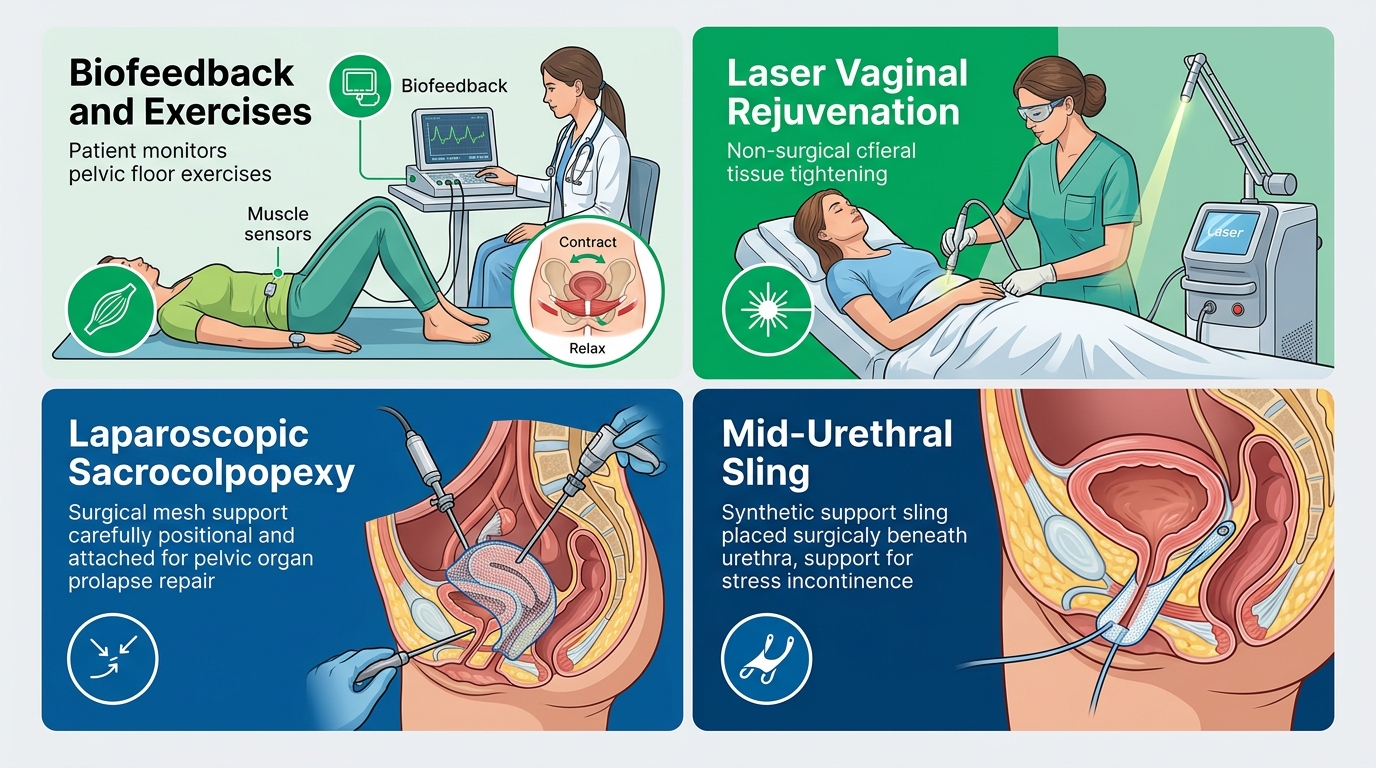
Comparison of advanced treatment options for pelvic floor conditions.
We encourage you to take the next step toward renewed confidence. For a detailed recovery timeline after pelvic floor therapy, visit our pelvic floor therapy recovery guide. Our team combines Expert Attentive Care with proven medical expertise, and we are here for you from your first consultation through every phase of recovery. Results may vary based on individual patient conditions and circumstances.
Common Questions About Pelvic Floor Therapy
What is pelvic floor therapy?
It is a non-surgical treatment to strengthen the muscles that support the bladder, uterus, and bowel.
Can it help with urinary incontinence?
Yes, this therapy can significantly reduce leaks by improving muscle control and coordination.
Can it help with pelvic organ prolapse?
Absolutely, it can improve support and ease symptoms related to pelvic organ prolapse.
Does therapy help with endometriosis pain?
Yes, therapy can reduce pelvic pain associated with Endometriosis Fort Lauderdale by relieving muscle tension.
Is therapy painful?
Most patients find it comfortable; we guide you gently through every step.
How long until I see results?
Improvements often appear within a few weeks of regular sessions, though individual results vary.
We are here for you with Expert Attentive Care. Please schedule a consultation to discuss your personalized treatment plan.
Your Path to Better Pelvic Health with First Class OBGYN
Your path to better pelvic health with pelvic floor therapy in Fort Lauderdale begins at First Class OBGYN. Our board-certified (US and EU) team provides urogynecological treatments, non-surgical vaginal rejuvenation, laser and radiofrequency therapy, and minimally invasive surgery for conditions like pelvic organ prolapse and urinary incontinence at our Miramar, Weston, and Pembroke Pines locations. We are committed to helping women restore their confidence through genuine Expert Attentive Care. We invite you to schedule a consultation to discuss your personal pelvic health goals. Individual treatment outcomes depend on patient factors and clinical circumstances.


